Describe the Basic Process of Dna Replication.
DNA unwinds at the origin of replication. Involves separating the two parent strand and.

What Are The Steps Of Dna Replication
To be completed every Friday by 2pm For each standard that.
. DNA replication is a process in cells that occurs before the beginning of every cell division process. Basic Mechanisms of Replication DNA replication is semiconservative. Recognition of initiation point DNA replication starts at a specific point called initiation point or origin where replication fork begins.
DNA helicase disrupts the hydrogen bonding between base pairs to separate the strands into a Y shape known as the replication fork. Helicase opens up the DNA-forming replication forks. A segment of DNA has undergone a mutation in which one nucleotide has been changed.
These results could only be explained if DNA replicates in a semi-conservative manner. This is a nucleotide sequence of 100 to 200 pairs of bases. And for this reason therefore the other two models were ruled out.
DNA polymerase III ATP GTP TTP CTP. The A base can only bind to a T and a C can only bind to a. Replication has Direction 3.
Basic process and enzymology of DNA synthesis and the next chapter will cover regulation of DNA replication. Students will be able to. This notation signifies which side group is attached the DNA backbone.
Replication of Both Strands Proceeds by the Addition of Nucleotide Monomers in the 5-3 Direction and Others. Recall the basic structure of DNA including the complementary base pairings describe the process of semiconservative DNA replication explain the role of DNA helicase DNA polymerase and DNA ligase in semiconservative DNA replication describe how errors introduced in DNA replication can be corrected. Students will be able to.
The new nucleotides are then joined together to form two new strands of DNA paired with each of the original parental. Binding of DNA around an initiator protein complex DNA-A ATP 30-40. Single-strand binding proteins coat the DNA around the replication fork to prevent rewinding of the DNA.
A codon table like the one shown below lists the amino acids coded for by particular triads of mRNA bases. A mechanism of DNA replication in which each of the two strands of parent DNA is incorporated into a new double stranded DNA molecule. The original sequence was ACG and the new sequence is ACA.
What is the first step following the formation of a. The following steps are involved in DNA replication. This area will be the template for replication to begin.
Find an answer to your question Describe the basic process of DNA replication and how it relates to the transmission. By the early 1950s it was clear that DNA was a. Replication Starts off a Unique Point on Bacterial and Viral Chromosomes 4.
In this article we will discuss about the six basic rules for DNA replication. Briefly describe the basic process of DNA replication. Energy of Replication The nucleotides arrive as nucleosides DNA bases with PPP P-P-P energy for bonding DNA bases arrive with their own energy source for bonding bonded by enzyme.
During transcription the DNA base sequence is transcribed into a complimentary mRNA sequence. DNA helicase unwinds the double helix of the parental DNA molecule. Such proteins along with DNA directed RNA polymerase.
The central enzyme involved is DNA polymerase which catalyzes the joining of deoyribonucleoside 5-triphosphates dNTPs to form the growing DNA chain. The first step in DNA replication is to unzip the double helix structure of the DNA molecule. The first step is to unzip the double-helix structure in DNA molecule.
DNA replication is regarded as the transmission of genetic information in that it ensures the production of another identical information same as the old and this is moved during cell division to a new daughter cell result of the cell division process. Replication depends on the pairing of bases between the two strands of DNA. The complete process of DNA Replication involves the following steps.
DNA replication is the process of producing two identical copies of DNA in which each template for the synthesis of a new complementary daughter strand. Replication is a Semi-conservative Process 2. The new strands will be complementary to the parental or old strands.
The process of DNA replication can be summarized as follows. We begin our investigation by describing the basic model for how nucleotides are joined in a specific order during DNA replication. The two separated strands will act.
Specific initiation proteins recognize the initiation site on DNA. The separation of the two single strands of DNA creates a Y shape called a replication fork. Replication occurs in three major steps.
View EOC Standardsdocx from BIO MISC at University High Orlando. What is DNA replication and how do you describe it. This is carried out by an enzyme called helicase which breaks the hydrogen bonds holding the complementary bases of DNA together A with T C with G.
DNA is directional in both strands signified by a 5 and 3 end. Three basic steps involved in DNA replication are Initiation elongation and termination. DNA Replication DNA is semiconservative Semiconservative replication.
This is done by an enzyme called Helicase which breaks down the hydrogen bonds that hold the complementary bases of DNA together A and T C and G. The opening of the double helix and separation of the DNA strands the priming of the template strand and the assembly of the new DNA segment. What will be an ideal response.
The DNA B or helicase unwinds ori C origin of replication and extends the single stranded region for copying. During DNA replication each of the two strands that make up the double helix serves as a template from which new strands are copied. Then DNA polymerase pairs free nucleotides to be complementary to the parental DNA strand.
Recall the basic structure of DNA including the complementary base pairings describe the process of semiconservative DNA replication explain the role of DNA helicase DNA polymerase and DNA ligase in semiconservative DNA replication describe how errors introduced in DNA replication can be corrected. These are extended in both directions.
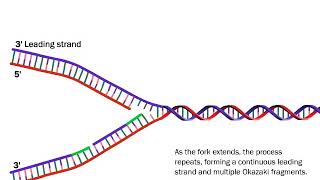
Dna Replication The Process Simplified Youtube
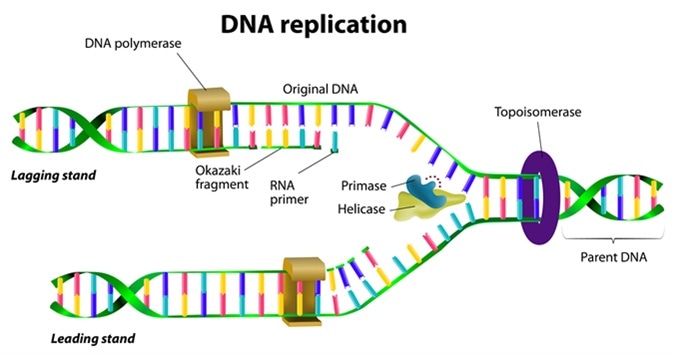
Dna Replication And Repair

Dna Replication Steps Process Mechanism I Research Tweet


Comments
Post a Comment